Exploration · Deeper Exploration
The First Impression Invites Us In. The Last One Stays With Us.
An entrance is more than a passage between outside and inside. It creates expectations, provides orientation and prepares us for our encounter with a place.
The entrance already tells us something about the place beyond it.
Even before we step through a door, we perceive signals: how clearly the entrance can be seen, the proportions, the materials, the light and the way the building seems to open towards us.
These impressions can awaken curiosity and inspire confidence. They can also make us hesitate, search for our way or feel kept at a distance.
But the experience does not end when we enter. What we see when leaving a building can influence how we remember it.
Four Observations
Looking at the Entrance from Different Perspectives
Observation 01 · Visibility
An Entrance You First Have to Find
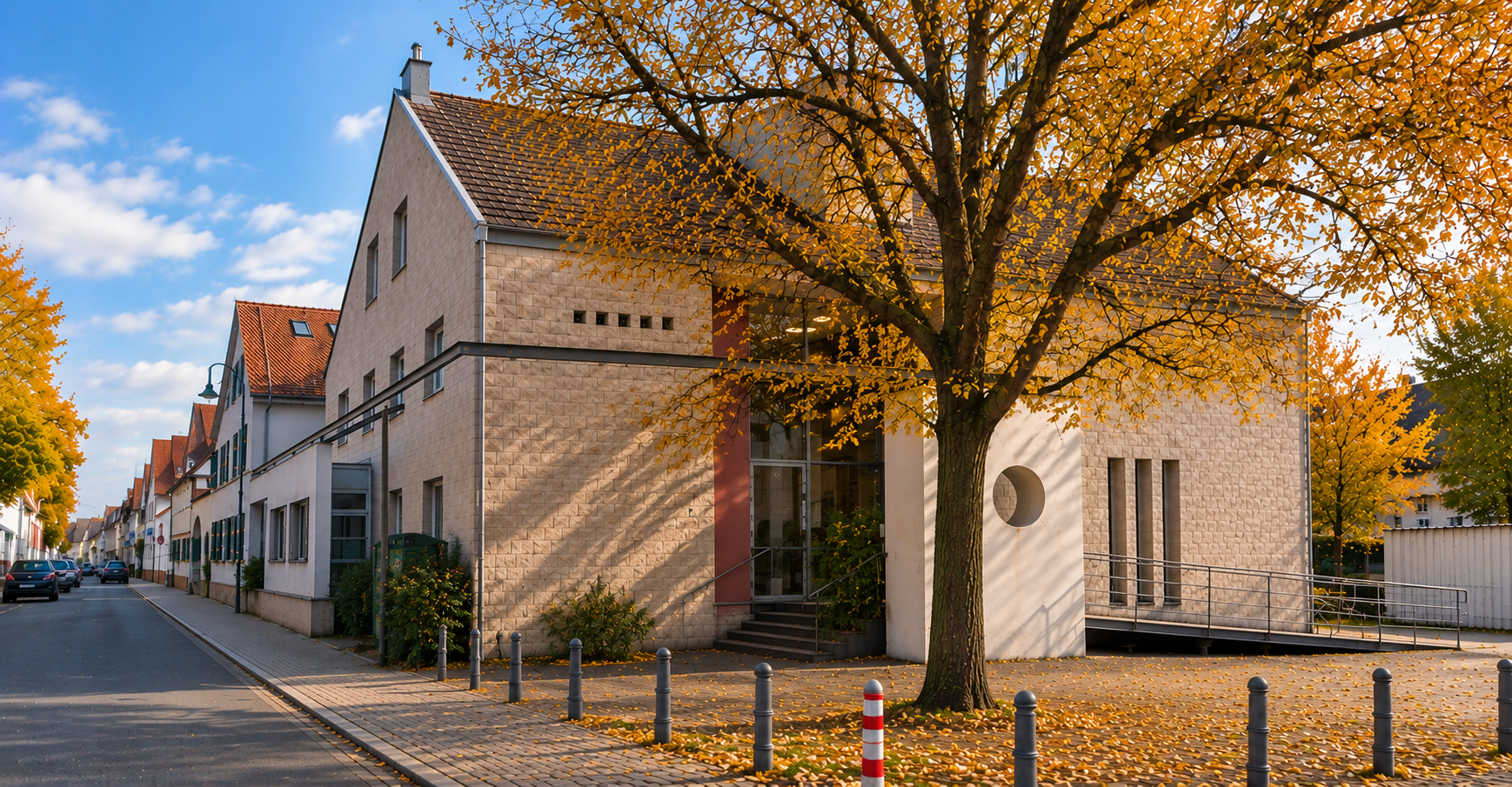
In this image, a tree occupies much of the foreground. Its foliage attracts our attention and partially conceals the steps and the entrance to the building.
The building is clearly there, but its entrance does not immediately stand out in our perception. Before moving towards the door, we first need to understand where the actual access is.
Abundant vegetation can create a pleasant atmosphere and give a place character. But when it conceals the route to the entrance, it can also weaken the sense of invitation.
The question is therefore not whether we should do without trees or plants. It is about considering what a person sees when arriving for the first time.
At what point do you recognise the entrance? Does the route seem obvious, or do you first have to look for it?
Observation 02 · Reflections and Transparency
Glass Is Transparent. But Does the Entrance Feel Open?
Glass is often used to express modernity, lightness and openness. Yet a glass façade is not necessarily perceived as transparent.
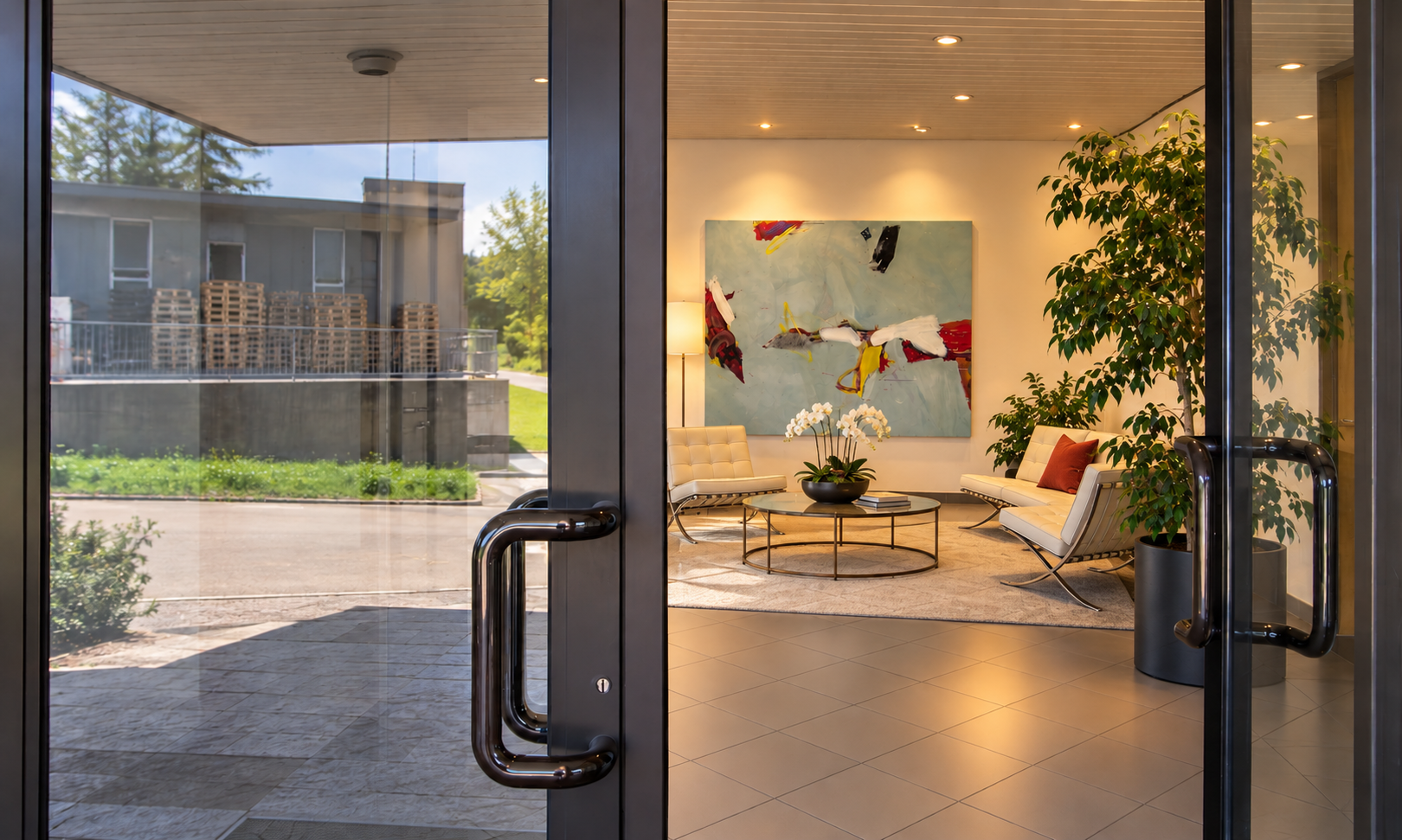
Here, the doors reflect the outdoor surroundings. Our eyes first encounter these reflections, even though an invitingly furnished lobby lies just behind the glass.
Two impressions overlap: what the surface of the glass reflects back to us and what it allows us to see beyond it.
Depending on the light, the viewing angle and the contrasts, reflections may dominate our perception. They can make it more difficult to read and understand the interior space.
The transparency of a material does not necessarily create a sense of openness.
For someone arriving, it is not only the architectural quality of the façade that matters. What matters is also how easily they can understand where to enter and what awaits them inside.
Does your gaze naturally pass through the glass doors, or does it remain caught by the reflections? What do you notice first?
Observation 03 · Invitation and Orientation
When an Entrance Becomes an Invitation
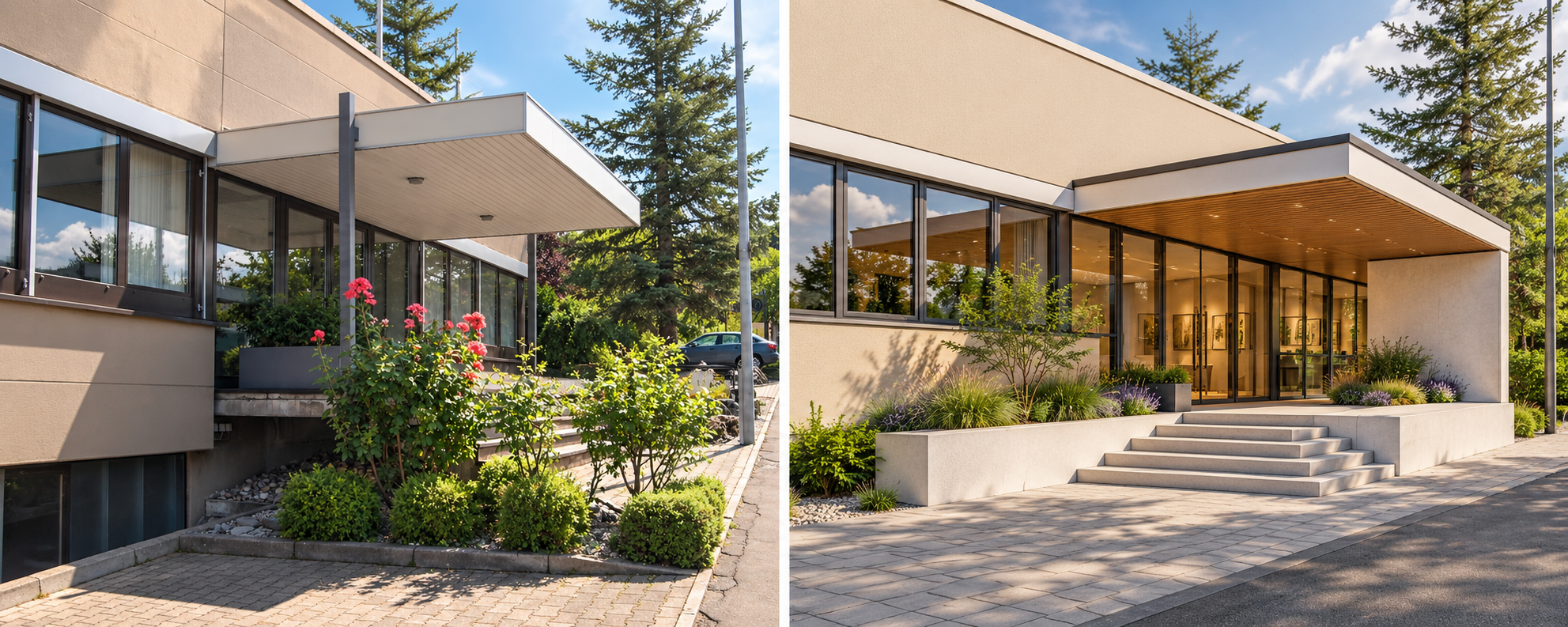
These two images allow us to compare different ways of organising access to a building.
In the redesigned version, the steps are more generous, the entrance area is more clearly defined and the outdoor design guides movement towards the door.
The wooden canopy emphasises the point of arrival. The vegetation frames the entrance without obscuring it. Together, these elements make the route easier to understand.
This is not simply about making the façade more attractive. The design helps people recognise the route, find their way and feel expected.
A welcoming entrance does more than look attractive: it clearly shows people how to enter.
This distinction is particularly important in public buildings, businesses, educational institutions and all places that welcome people who are not yet familiar with the surroundings.
Which version would make you feel more naturally inclined to move forward? What changes your perception: the shapes, the proportions, the route or the atmosphere?
Observation 04 · Last Impression
An Entrance Is Also an Exit
When a building is designed or presented, attention often focuses on arrival: the façade, the door, the lobby and the first impression.
Yet most visitors later pass through the same entrance in the opposite direction.
As they leave, their gaze turns towards the outside. What they see may be very different from the image that welcomed them when they arrived.
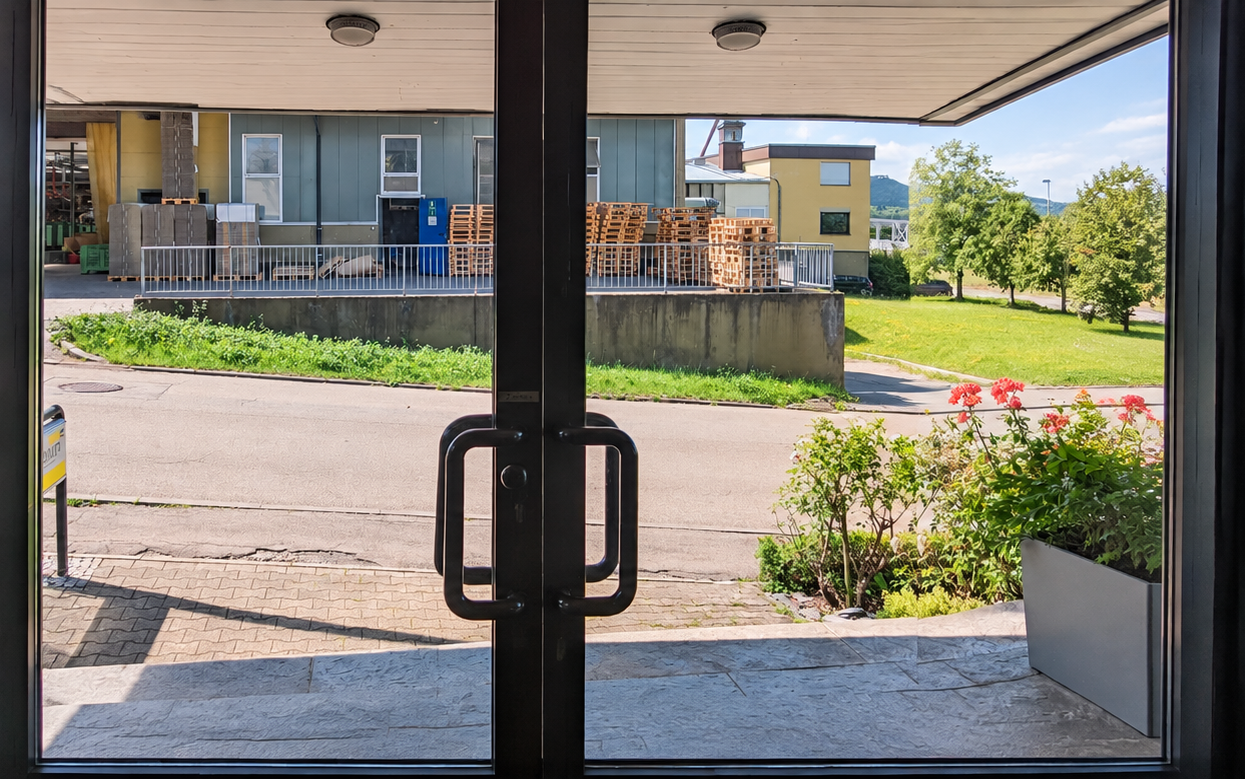
In this example, the view from inside opens onto a predominantly functional environment, characterised by a courtyard and storage areas.
These surroundings may perfectly fulfil the practical needs of the building. But they do not necessarily create the same impression as the entrance itself.
The perspective of someone leaving the building therefore deserves just as much attention as the perspective of someone arriving.
The first impression may invite us in. The last one contributes to what remains in our memory.
If you were leaving this building, what image would you take away? Would it correspond to the impression you experienced when you arrived?
Changing Perspective
Look at Your Entrance from the Perspective of Those Who Use It.
We often evaluate a building from an external viewpoint: through a photograph, a floor plan or an architectural rendering.
But the people who use a building experience it differently. They approach it, look for an entrance, cross a threshold, find their way and eventually leave.
To continue your own exploration, ask yourself a few questions:
- Is the entrance recognisable as soon as someone approaches the building?
- Is the route to the door clear and natural?
- Do the materials and reflections make orientation easier, or do they create uncertainty?
- Does the entrance create an impression consistent with the purpose of the place?
- What do people see when they leave? What is the last image they take away with them?
Sometimes all it takes is a change of perspective to discover effects we had not noticed before.
Exploration
Spaces Have an Impact. Always! Everywhere!
The entrance is just one example
of how a space can influence
our perception.
Other clues invite us
to continue exploring
and to understand more deeply
the effects of the places
we live in,
move through
and use.