Exploration · Meeting Room
When the Space Takes a Seat at the Table
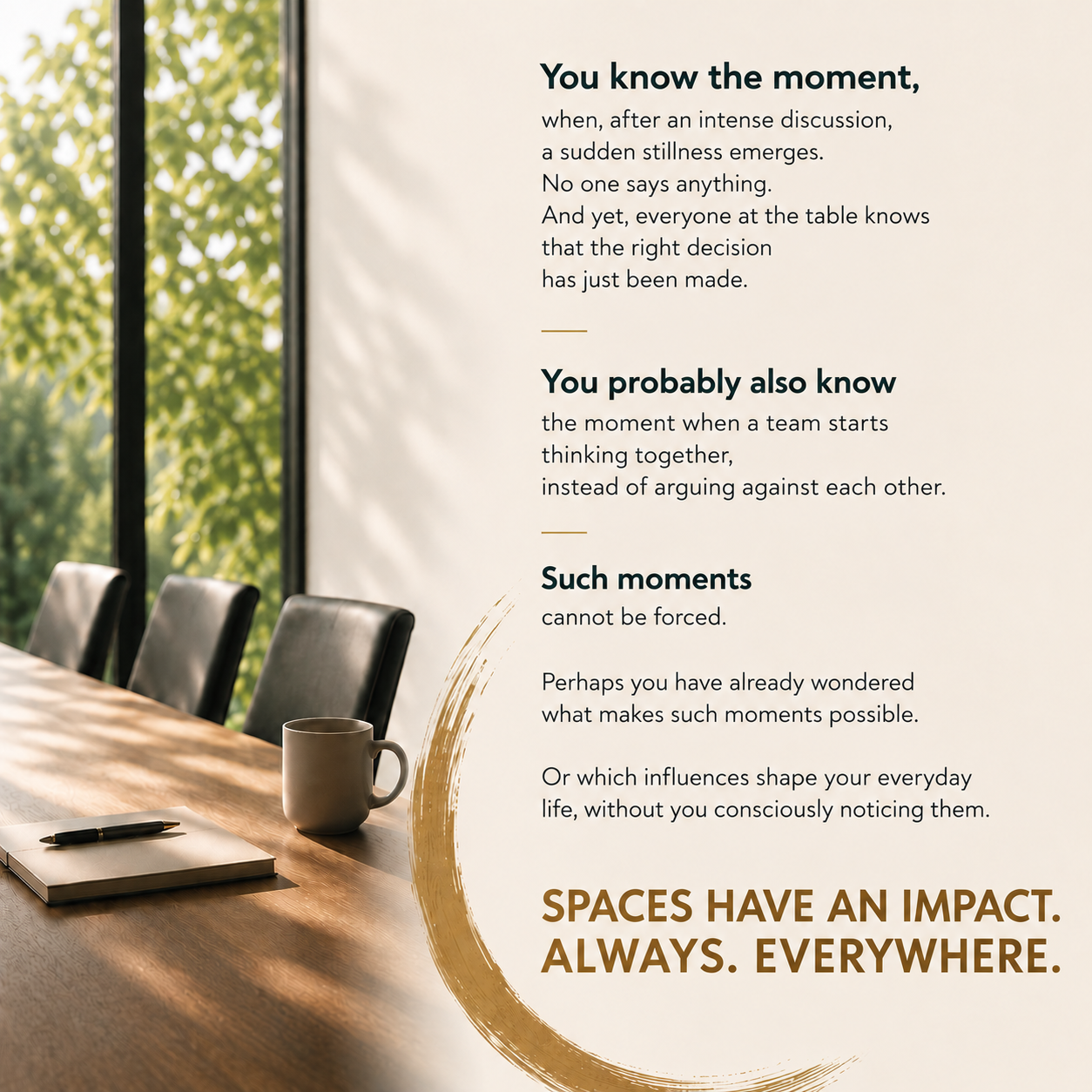
Such moments cannot be forced.
But the conditions under which they can arise can be influenced.
A meeting room is far more than a shell containing a table, chairs and technology. Its proportions, the arrangement of the seats, the light, sight lines, materials and the spatial relationship between the people all influence how we behave during a conversation.
Especially in difficult discussions, our attention is usually focused on the people: Who leads? Who speaks? Who listens? Which interests are meeting?
The space itself is rarely perceived as an influencing factor.
Two spaces · two effects
What changes when only the space changes?
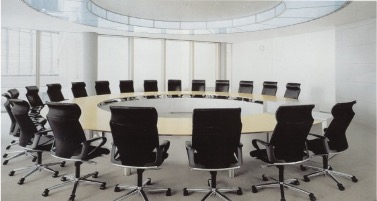
Oriented towards one another
The circular arrangement draws attention towards a shared centre. All participants can perceive one another, eye contact arises more easily and no seat is clearly positioned outside the group.
The chairs also have sufficient space and can be moved freely. The circular form of the ceiling echoes the shape of the table. The table, seating arrangement and ceiling therefore speak a similar geometric language. The room appears calm, coherent and ordered.
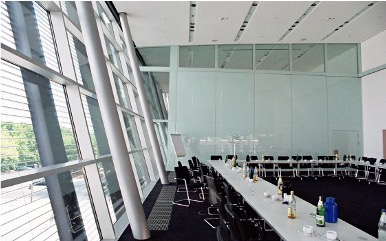
Competing directions
The long table creates greater distances and a strong longitudinal direction. At the same time, the angled exterior wall follows another direction. The lines and elements of the ceiling clearly follow neither the geometry of the table nor that of the exterior wall. Several spatial directions therefore compete with one another.
The irregular arrangement of the frosted-glass surfaces introduces another visual accent. Even if their exact relationship to the entrance cannot be clearly identified in the photograph, they add further tension to the perception of the room.
The chairs are also positioned much more closely together. Even small movements or simply pushing a chair back can create noise and disturb the other participants. Movement itself therefore becomes an additional stimulus in the room.
Spaces influence the culture of conversation.
A spatial arrangement is not inherently right or wrong. What matters is which form of encounter and communication it is intended to support.
It is rarely a single element that acts in isolation. The shape of the table, the seating arrangement, freedom of movement, the geometry of the room, wall and ceiling lines, light and sight lines all overlap.
When these spatial signals are aligned, a sense of calm can emerge. When many directions, movements and visual stimuli compete with one another, a sense of restlessness can develop instead – something we may perceive without consciously being able to identify its cause.
This becomes apparent even in small everyday situations: Can a chair be pushed back without disturbing the person next to it? Can everyone see everyone else? Is there a shared spatial centre? Or does our perception constantly have to process different directions and stimuli?
For presentations or clearly structured meetings, a linear arrangement can certainly be appropriate. But when different interests need to be brought together, conflicts resolved or new ideas developed collectively, different spatial conditions are often required.
A good meeting room does not resolve a conflict and does not make decisions. It can, however, create conditions in which people listen more easily, reconsider their positions and think with one another rather than against one another.
Spatial design therefore does not only support creative processes. It can also contribute to a calm, constructive and de-escalating atmosphere for conversation.
Your exploration
At your next meeting, take a closer look at the space.
How are people positioned in relation to one another?
Who can see whom directly?
Where do closeness, distance or opposing positions emerge?
Which lines, forms and directions of movement shape the space?
Can everyone move without disturbing the others?
And does the atmosphere change when the same people meet in a different room?
Perhaps the space takes a seat at the table more often than we realise.