Exploration · Clue 03 · Deeper Exploration
The Most Beautiful Workplace Is Not Always the Best.
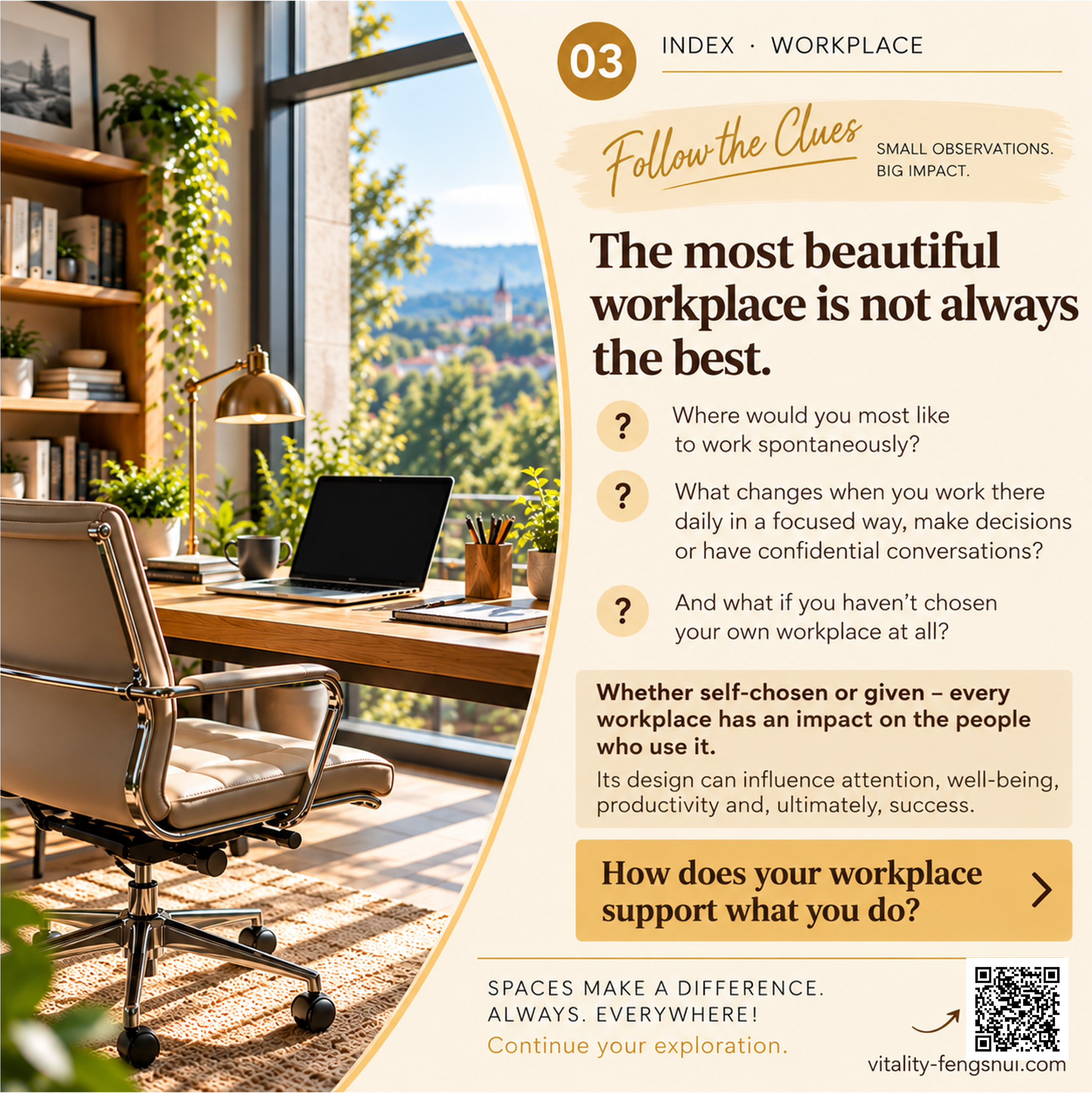
Does your workplace support you in what you do there?
A workplace is more than a desk
with a chair, computer and good lighting.
Its spatial conditions can influence
how we work, concentrate,
make decisions and put
our abilities to use.
01 · A Change of Perspective
A Beautiful Workplace – but Is It the Right One?
Imagine you could choose your workplace freely. Would you choose the place with the most beautiful view? A spacious desk? A bright, open room?
What seems attractive at first does not necessarily meet the demands we actually need to fulfil in that place.
Perhaps you need peace and quiet for a demanding task. Perhaps you have to make an important decision or hold a confidential conversation. Or perhaps you are looking for a place where new ideas can emerge.
But rather: What should this workplace enable me to do?
There is another aspect to consider: many people do not choose their workplace themselves. It is assigned to them or determined by organisational and operational circumstances.
Nevertheless, its spatial characteristics affect the people who use it. This makes it particularly interesting to examine a workplace from the user’s perspective.
02 · A Small Change
Same Room. Same Furnishings. Different Effect?
Take a look at these two workplaces. The furnishings and surroundings are largely identical. The crucial difference lies in the orientation of the desk and therefore in the sitting position of the person working there.
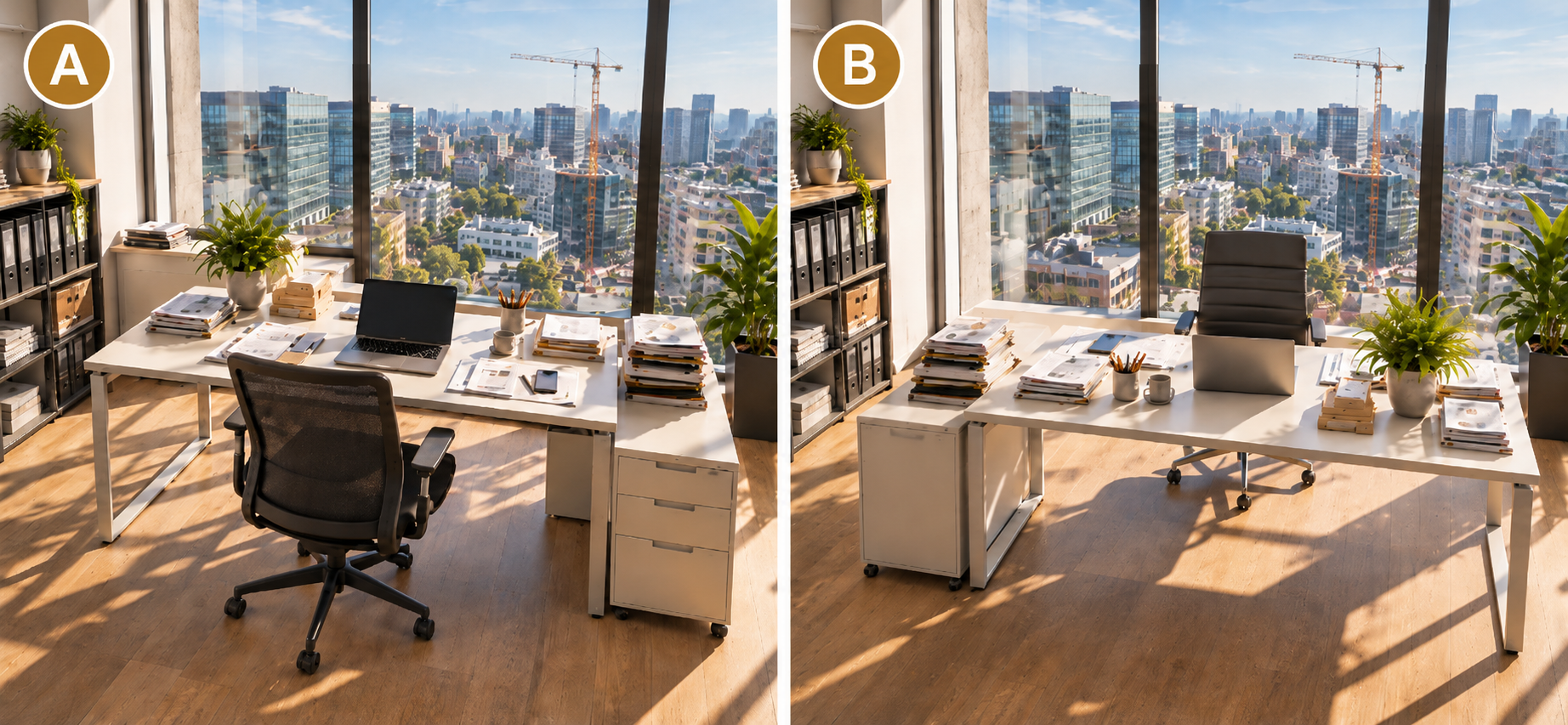
What Changes for the User?
In one position, the gaze is directed straight towards the windows. Movement and activity outside may therefore attract more attention.
In the other position, the relationship between the workplace, the room and the windows changes. The view into the room and awareness of what is behind the person become different spatial conditions.
These images do not automatically show a right and a wrong workplace. Instead, they illustrate how even a relatively small spatial change can influence the conditions in which a workplace is used.
03 · Views and Attention
When the View Becomes Part of the Action
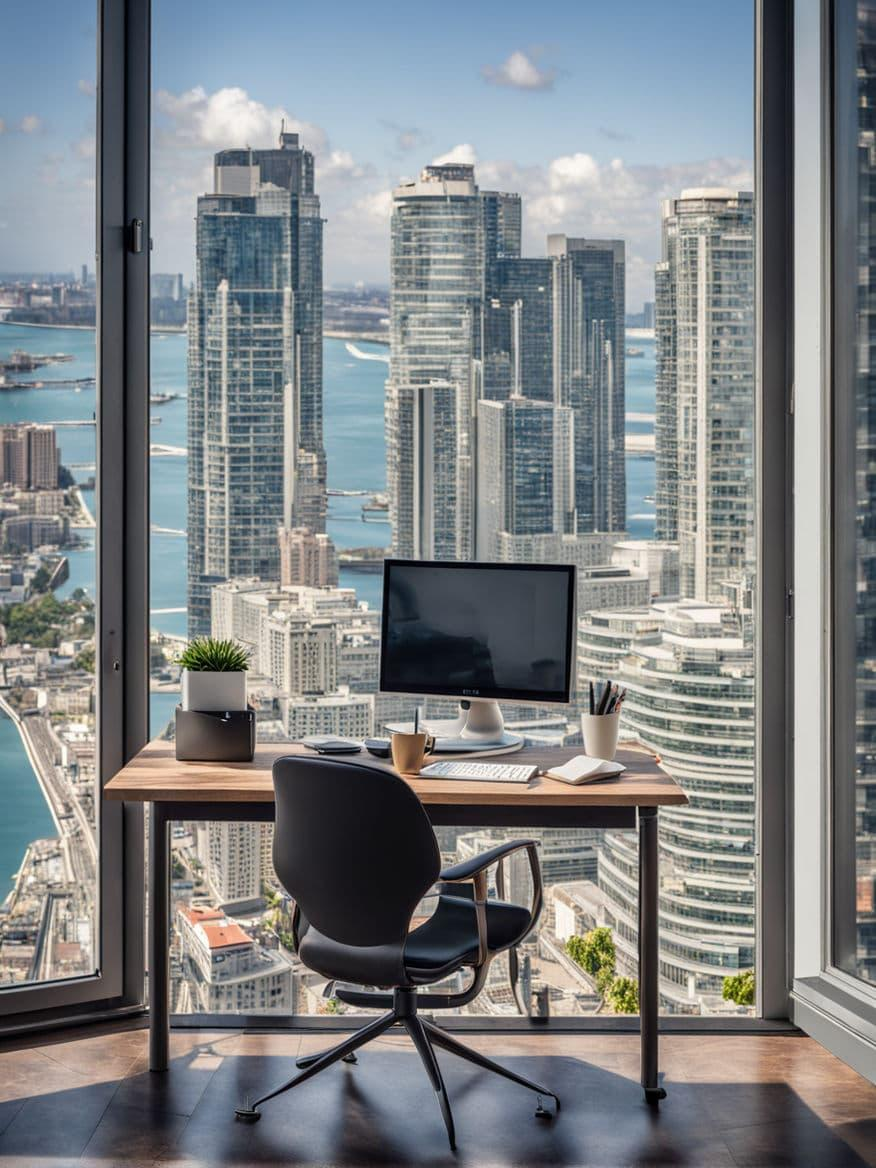
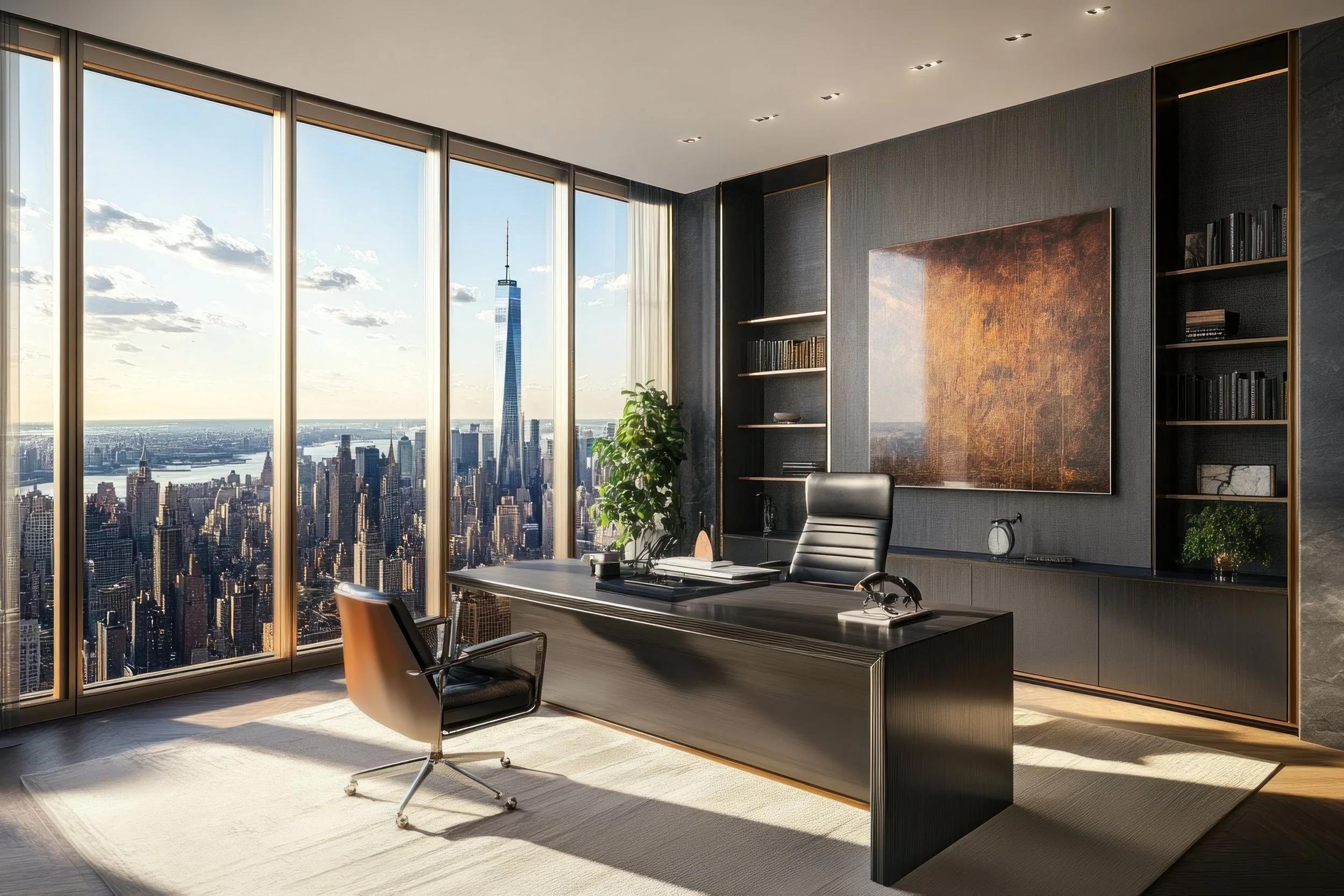
Large windows, plenty of daylight and an expansive view can make a workplace particularly attractive.
But what happens when there is constant movement outside? Vehicles, people, construction work or changing light conditions can repeatedly draw our attention away.
This is not necessarily a disadvantage. A view can inspire, provide moments of relaxation and stimulate creative thinking.
For tasks requiring concentration, however, those same stimuli can become distractions.
04 · Support from Behind
A Sense of Security Without Losing the View
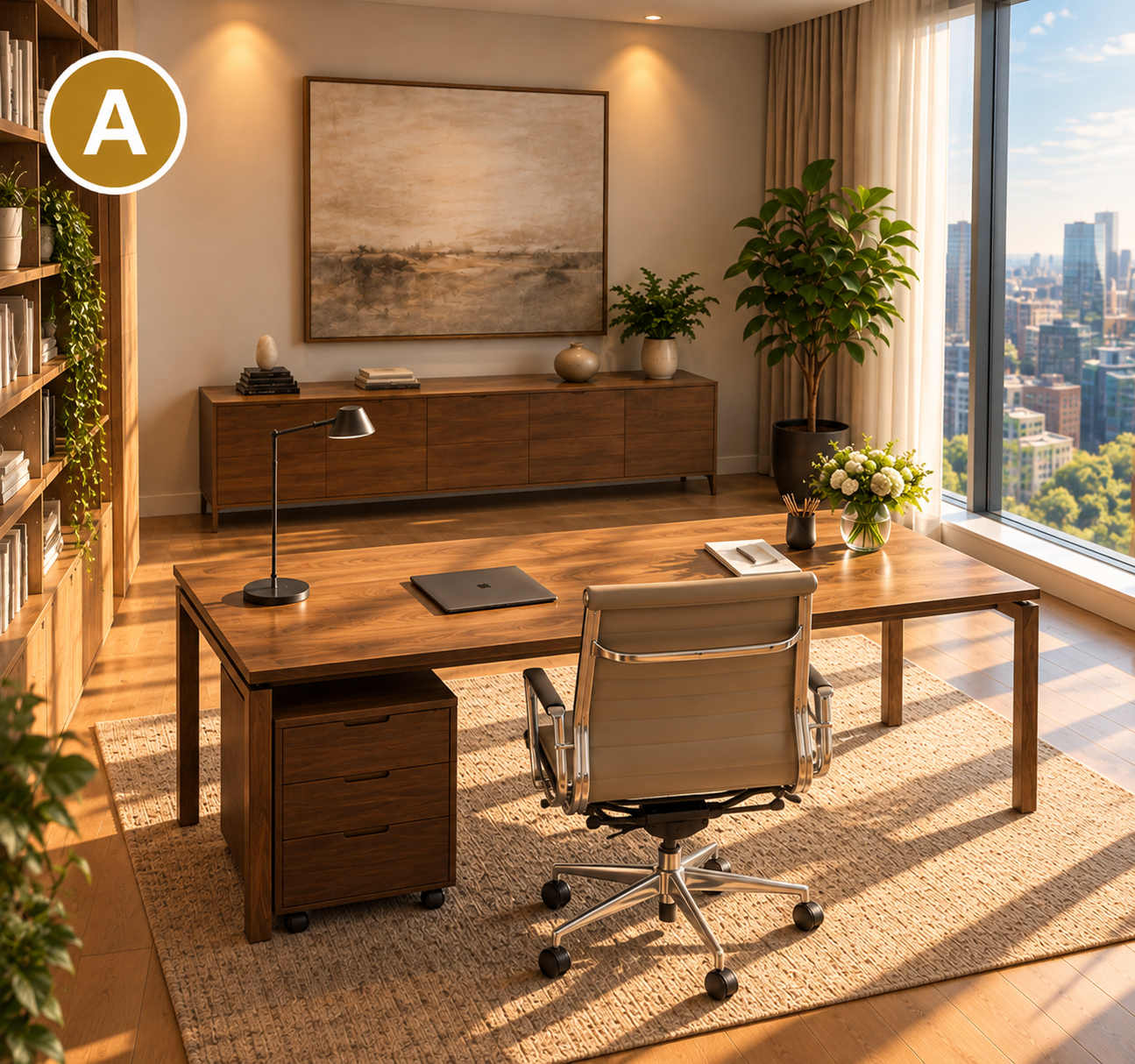
A workplace with a solid wall or a protected area behind the person sitting there creates a different spatial situation from a seat standing freely in the room.
In classical Feng Shui, this quality is regarded as support from behind.
The underlying idea is easy to understand: Someone who knows that their back is protected and who can survey the room may need to devote less attention to what is happening behind them.
A view to the side also maintains a connection with the outside world. Light, spaciousness and orientation can therefore be combined with a more protected sitting position.
05 · Orientation Within the Room
Seeing What Happens Without Having to React Constantly
Alongside support from behind, the direction of view also plays an important role.
Someone who can see the door can more easily notice when another person enters the room. This can be particularly welcome during concentrated work, conversations or decisions involving significant responsibility.
The desk does not have to stand directly opposite the door. A position slightly to one side is often more favourable, as it allows orientation without placing the workplace directly in the movement zone of the entrance.
Here, too, no single rule determines the quality of a workplace. What matters is the interaction between its spatial characteristics and its intended use.
06 · Development and Potential
What Works Today May No Longer Be Right Tomorrow.
The requirements of a workplace change with the tasks, responsibilities and people who use it.
Someone concentrating on a complex task may need different spatial conditions from someone developing creative ideas, leading a team or making difficult decisions.
Personal development can also change these requirements. New tasks, greater responsibility, different working processes or changing forms of collaboration may call for different kinds of spatial support.
A workplace should therefore not be considered solely in relation to present circumstances. It is also worth asking whether it enables development or makes necessary changes more difficult.
Or does it also provide space for them to develop their abilities and potential?
This does not mean that every workplace must constantly be redesigned. Often, a different sitting position, another direction of view, better screening or an adjustment in how the space is used can already make a noticeable difference.
07 · The Business Perspective
Workplace Design Also Shapes the Conditions for Success.
For businesses, workplaces are about far more than furnishings or the amount of office space available.
They provide the spatial conditions in which employees carry out their daily tasks, make decisions, communicate with one another and develop solutions.
Their design can help determine how well people concentrate, how easily they collaborate and whether they can use their abilities effectively.
The quality of a workplace therefore also has a business dimension.
A well-equipped office is therefore not automatically a good workplace. What matters is whether its spatial characteristics support the actual requirements of the people working there.
A Question for Business Owners and Leaders
Are the workplaces
in your organisation
merely furnished
to fulfil a function?
Or do they also support
people in using their abilities,
working productively
and achieving success?
The answers may reveal
where spatial conditions
could be improved –
for the benefit of employees
and the organisation alike.
08 · Your Own Exploration
Look at Your Workplace from a Different Perspective.
The aim is not to immediately classify your workplace as good or bad. Begin with a few simple observations.
Direction of View
Where does your gaze fall when you sit at your workplace? What is directly in front of you?
Support from Behind
What is behind you? Can people approach you without your noticing?
Views and Distractions
Which movements, lighting conditions or events regularly attract your attention?
Tasks and Requirements
Does your workplace support concentrated work, communication, decision-making and the tasks you need to carry out there?
One Additional Thought
Imagine rotating your desk
by 90 or 180 degrees.
What would change?
- Your direction of view?
- Your awareness of the door and what is happening in the room?
- The view and possible distractions?
- Your sense of openness, orientation and support from behind?
- How well the workplace suits the tasks you actually perform?
Even imagining this change can help you become more aware of spatial relationships.
The Exploration Continues
A Workplace Can Do More Than Simply Function.
Its quality is not determined solely by its design or furnishings, but above all by how well it supports people in their daily work.
This applies to individual users as well as to organisations seeking to provide suitable working conditions for their employees.
Perhaps change begins with a simple question:
What Could My Workplace Help Me Do Better?
Spaces Have an Impact. Always! Everywhere!
vitality-fengshui